
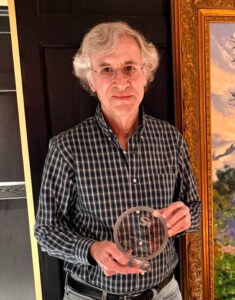
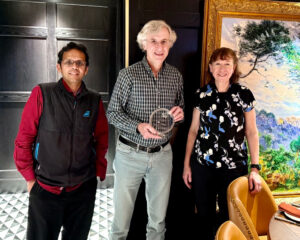
The Silicon Integration Initiative (Si2) has honored Jerry Frenkil with an Si2 Outstanding Contributions Award, acknowledging over 40 years of technical and executive leadership in semiconductor EDA low-power design. Jerry, former Si2 Director, OpenStandards, and Technical Advisor, retired from Si2 in January. Leigh Anne Clevenger, Si2 VP, Technology, asked Jerry for his insights into the semiconductor industry over the course of his career.
Clevenger: Describe the most impactful change in the semiconductor industry that you have observed.
Frenkil: When I started my semiconductor career in 1978, working on the Z-80 microprocessor in depletion mode NMOS, we thought and designed with polygons and transistors. These days we think and design with entire systems. The ratio of the transistor count of a contemporary integrated system, such as the nVidia H200 (with ~ 80 billion transistors), to the Z-80 (with 8,500) is about 10 million to 1. This extraordinary shift and increase in integration and design efficiency was enabled by Design Automation. In short, Design Automation changed the way we think and design.
Clevenger: What event in your career is the most memorable and why?
Frenkil: The most memorable event in my career was founding Sente, the first pure play EDA company focused on power and, subsequently, becoming a leader in low power design. I worked with outstanding people all over the globe on hard and meaningful problems. Along the way we changed how engineers thought about low power design and helped usher in major advances in mobile computing.
In our early days of bringing RTL power analysis to market, on several occasions we got responses of incredulity to our claims of RTL power analysis and optimization like “It seems like black magic to me” and “I can’t possibly understand how you can do this”. Receiving comments like that, and delivering the radically advanced software substantiating our claims, was an awful lot of fun!
Clevenger:What were you working on when you most enjoyed work? What was the work environment like then?
Frenkil: The most enjoyable times in my career involved tackling challenging projects, whether in IC design or founding a startup enterprise.
At VLSI Technology I led a design group known for taking on challenging projects. One 1989 project for Thinking Machines, a pioneer in massively parallel computing for AI, resulted in the most complex chip VLSI Technology had built to that date. The designs were successful, but consumed twice the power that we had expected. Addressing that issue led me to think about power deeply and broadly, and I realized that “the power problem” was only going to get more challenging, more widespread, and more important. That epiphany led directly to my founding Sente. At that time, practically everything related to IC power was new, with little history or research to guide the way. Working in that greenfield was challenging, stimulating, and exciting.
Clevenger: What advice would you give your younger self when starting out?
Frenkil: Be Bold! Significant advances, whether in technology or personal growth, rarely occur without boldness of some sort in vision and commitment. I learned this lesson directly, sometimes by intention and sometimes by happenstance. However, I wish I could have learned it sooner.
Clevenger: What changes do you believe would benefit Si2?
Frenkil: Power model generation continues to be a challenge and to date has largely been an ad-hoc process. With the standardization of UPM as IEEE 2416 for system level power modeling, and recent activities focused on machine learning, Si2 is well positioned to develop new automated power model generation methods, leveraging both 2416 and AI. Such a development would be a major advance addressing power management on a problem that is only going to become more and more challenging and important. We’ve seen this movie before.
Operationally, I feel that Si2 should spend more time visiting members in-person, getting to know them and listening to their needs. Meetings these days most often occur via teleconference. But in-person meetings are so much better because people can better relate to others in person. It takes more time and effort for sure, but it better enables the development of meaningful relationships.
Clevenger: Anything else you would like to share?
Frenkil: An unusual event is perhaps worth mentioning. I was privileged to be a “fly on the wall” during the first and, as far as I know, only meeting between two major historical figures in the semiconductor industry, Ted Hoff and Gary Boone. Hoff was widely credited as the inventor of the first microprocessor at Intel, the 4004. Boone was my mentor and good friend and was widely recognized as the inventor at TI of the first microcontroller, the TMS 1000. He and I had a design review with Hoff of a graphics processor that our team developed for Atari (where Hoff went after leaving Intel). After we completed the review Gary and Ted began to reminisce about the events that led each of them, largely independently, to break new technological ground and set the stage for the digital revolution. The rest, as they say, is history.
On behalf of the entire Si2 organization – Thank you, Jerry!